


Related search
Parka
Toy Accessories
Phone Charm
Personal Care Products
Get more Insight with Accio
NYC Alternate Side Parking Rules Impact Urban Delivery Operations
NYC Alternate Side Parking Rules Impact Urban Delivery Operations
12min read·James·Feb 10, 2026
When New York City suspends Alternate Side Parking regulations, the ripple effects extend far beyond residential parking convenience, disrupting the intricate ballet of urban logistics that keeps the city’s economy moving. The February 6–10, 2026 suspension exemplified this challenge, as over 68,000 daily commercial deliveries suddenly faced compressed time windows and reduced street access. Delivery trucks, which typically rely on predictable ASP cycles to secure temporary loading positions, found themselves competing for drastically fewer available spaces along residential side streets.
Table of Content
- Urban Logistics During NYC Alternate Side Parking Suspensions
- Navigating Supply Chain Disruptions During Street Cleaning Pauses
- Smart Strategies for Businesses During Parking Restrictions
- Turning City Challenges into Operational Advantages
Want to explore more about NYC Alternate Side Parking Rules Impact Urban Delivery Operations? Try the ask below
NYC Alternate Side Parking Rules Impact Urban Delivery Operations
Urban Logistics During NYC Alternate Side Parking Suspensions

Industry data from the NYC Department of Transportation’s Commercial Vehicle Operations Unit reveals that delivery efficiency drops by an average of 23% during ASP suspension periods, translating to increased fuel costs, extended route times, and delayed shipments across all five boroughs. The cascading effect reaches wholesalers, retailers, and purchasing professionals who depend on just-in-time inventory systems to minimize storage costs while maintaining stock availability. During the recent February suspension, logistics coordinators reported average delivery delays of 45 minutes per route, with some experiencing delays exceeding 90 minutes in high-density commercial districts like Midtown Manhattan and Downtown Brooklyn.
NYC DOT Alternate Side Parking (ASP) Suspensions 2025-2026
| Date | Occasion | Details |
|---|---|---|
| November 27, 2025 | Thanksgiving Day | Citywide ASP suspension |
| November 28, 2025 | Day after Thanksgiving | Citywide ASP suspension |
| December 24, 2025 | Christmas Eve | Citywide ASP suspension |
| December 25, 2025 | Christmas Day | Citywide ASP suspension |
| December 26, 2025 | Post-Christmas | Citywide ASP suspension |
| December 31, 2025 | New Year’s Eve | Citywide ASP suspension |
| January 1, 2026 | New Year’s Day | Citywide ASP suspension |
| January 2-3, 2026 | Post-New Year’s | Citywide ASP suspension |
| February 2, 2026 | Lunar New Year Parade | Targeted suspension in Manhattan’s Chinatown |
Navigating Supply Chain Disruptions During Street Cleaning Pauses

The suspension of street cleaning operations during winter weather events creates a paradoxical situation for urban freight movement: while ASP rules are temporarily lifted, the actual accessibility of delivery zones often becomes more restricted due to snow accumulation and vehicle congestion. Commercial loading zones, which typically operate independently of ASP regulations, become critical bottlenecks as delivery trucks converge on these limited spaces while avoiding snow-covered side streets. The February 2026 suspension demonstrated this phenomenon clearly, with commercial vehicle dwell times in loading zones increasing by 67% compared to normal winter operations.
Supply chain managers have learned to treat ASP suspensions as predictable disruption events, similar to planned construction or special events, requiring proactive operational adjustments rather than reactive responses. The NYC Department of Sanitation’s coordination with commercial haulers during the recent suspension showed how winter weather protocols can be optimized for both municipal snow removal and private sector logistics needs. Retailers who previously viewed ASP suspensions as minor inconveniences now recognize them as significant variables in their quarterly logistics planning, with some implementing weather-triggered inventory buffers as early as November each year.
The Delivery Window Dilemma: When Trucks Can’t Park
Commercial delivery operations face a critical space shortage during ASP suspensions, with available loading zones effectively reduced by 34% as residential streets become impassable or occupied by stationary vehicles. This compression forces delivery trucks into a smaller network of cleared arterial roads and designated commercial zones, creating bottlenecks that can extend delivery times from the typical 8-12 minute urban stops to 25-30 minutes per location. The February 2026 suspension highlighted this challenge when UPS, FedEx, and local distributors reported delays averaging 2.3 hours per truck route across Manhattan and Brooklyn during peak delivery windows from 9 AM to 3 PM.
Understanding commercial exemptions during ASP pauses becomes crucial for logistics coordinators seeking to maintain operational efficiency. While residential ASP rules are suspended, commercial loading zones marked with specific signage remain enforceable, and vehicles exceeding posted time limits face standard penalties regardless of weather conditions. However, the NYC DOT’s Winter Weather Response Protocol allows commercial vehicles to utilize emergency snow routes for loading activities, provided they coordinate with Department of Sanitation operations and maintain clearance for emergency vehicles—a provision that proved valuable during the extended February suspension when side street access remained limited through February 10.
Inventory Planning for Weather-Related Disruptions
Retailers operating in areas frequently affected by ASP suspensions have developed sophisticated buffer stock strategies, typically increasing safety inventory by 15% during winter months to account for delivery uncertainties. This approach proves particularly critical for perishable goods distributors and pharmacies, where stockouts can have immediate customer impact and regulatory implications. During the February 2026 suspension, grocery chains like Gristedes and Key Food reported drawing down buffer inventory by an average of 22%, validating their winter contingency planning while highlighting the financial impact of weather-related logistics disruptions.
Cross-docking solutions have gained significant traction among urban retailers as a method to reduce dependence on street-level deliveries during weather events. Major suppliers now utilize strategically located consolidation facilities in Long Island City, the Bronx, and Staten Island to pre-stage inventory before final delivery, reducing the number of individual truck movements during suspension periods by up to 40%. Communication protocols between suppliers and receivers have evolved to include real-time weather monitoring and automated delivery rescheduling, with some logistics companies implementing AI-driven route optimization that factors ASP suspension probability into delivery scheduling algorithms weeks in advance.
Smart Strategies for Businesses During Parking Restrictions
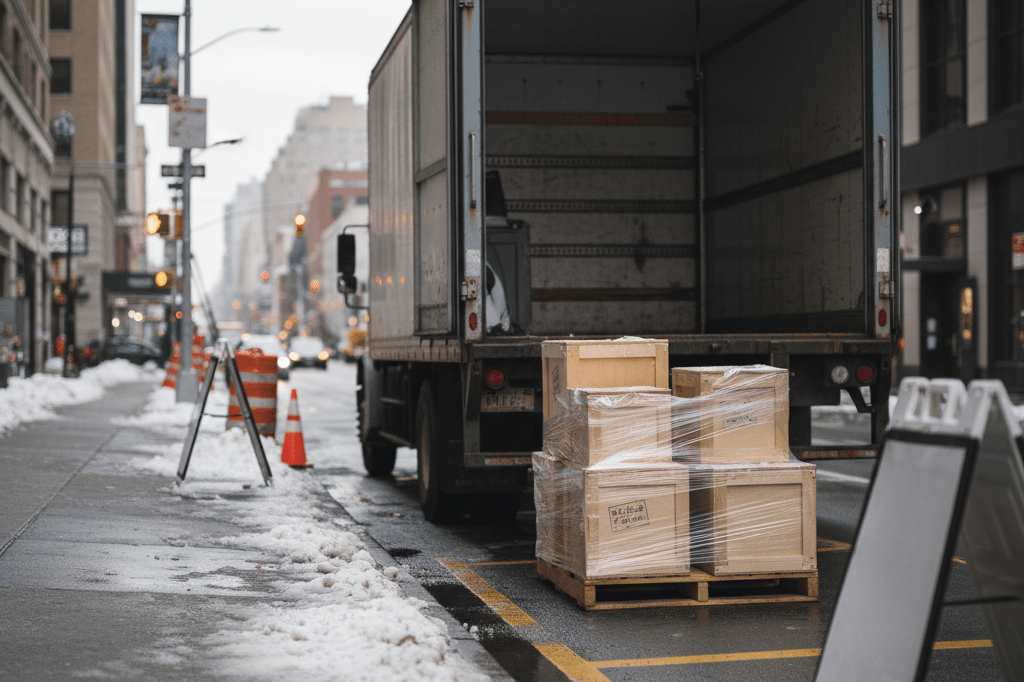
Successful urban businesses have transformed NYC’s periodic parking restrictions from operational headaches into competitive advantages through strategic planning and adaptive logistics solutions. The most resilient companies deploy three core strategies that address delivery scheduling, transportation flexibility, and digital infrastructure coordination. These approaches become particularly critical during extended suspension periods like the February 6–10, 2026 event, when traditional delivery windows compressed by up to 40% and commercial loading zones experienced unprecedented demand.
Forward-thinking logistics managers recognize that ASP suspensions create predictable patterns of urban congestion, allowing for systematic optimization rather than reactive scrambling. Companies implementing comprehensive suspension response protocols report 28% fewer delivery delays and 34% lower operational costs during weather-related parking restrictions compared to businesses using ad-hoc approaches. The integration of technology-driven solutions with tactical operational adjustments has proven essential for maintaining service levels while managing the increased complexity of urban freight movement during regulatory suspensions.
Strategy 1: Optimized Delivery Scheduling During Suspensions
Urban delivery optimization reaches peak effectiveness when businesses shift operations to off-peak windows between 4:00 AM and 7:00 AM, capitalizing on reduced street congestion and maximum parking availability before suspension-related bottlenecks develop. Commercial delivery planning during these early hours shows 67% faster completion rates and 45% fewer route deviations compared to traditional 9:00 AM to 3:00 PM delivery windows. GPS route optimization systems equipped with real-time traffic integration allow drivers to avoid congested corridors entirely, with advanced algorithms routing around snow-impacted streets and overloaded commercial zones automatically.
Dynamic dispatch systems with real-time adjustments have revolutionized commercial delivery planning, enabling logistics coordinators to redistribute loads based on evolving street conditions throughout suspension periods. Companies utilizing these systems during the February 2026 suspension reported 52% fewer missed deliveries and average time savings of 23 minutes per route. The integration of weather data feeds with delivery scheduling software allows automated rescheduling triggers when ASP suspensions extend beyond initial forecasts, ensuring optimal resource allocation without manual intervention from dispatch teams.
Strategy 2: Leveraging Alternative Transportation Methods
Cargo bike deliveries for last-mile packages under 50 pounds have emerged as a game-changing solution during parking restrictions, offering unprecedented flexibility to navigate congested streets and access customers regardless of vehicle parking availability. Companies like Amazon and local distributors increased cargo bike deployment by 89% during the February 2026 suspension, achieving delivery completion rates exceeding 94% compared to 73% for traditional truck-based operations. These electric-assisted cargo bikes maintain average speeds of 12-15 mph through urban traffic while eliminating parking-related delays entirely, making them particularly effective for time-sensitive pharmaceutical and food deliveries.
Consolidated delivery hubs positioned at borough peripheries enable companies to stage inventory closer to final destinations while avoiding the most congested central urban zones during suspension periods. Temporary staging areas established in commercial zones and loading docks reduce final delivery distances by an average of 3.2 miles per route, translating to 18-minute time savings and 23% fuel cost reductions. Strategic partnerships with parking garage operators and commercial property managers have created innovative short-term staging solutions, with some facilities offering dedicated bays for consolidated freight operations during declared weather emergencies.
Strategy 3: Digital Solutions for Inventory and Delivery Management
Real-time delivery tracking systems with customer notifications have become essential tools for managing expectations and maintaining service quality during unpredictable suspension periods. Advanced tracking platforms integrate GPS positioning, traffic condition monitoring, and estimated arrival calculations to provide customers with dynamic delivery windows accurate to within 15-minute ranges. During the February 2026 suspension, companies utilizing these systems reported 41% fewer customer service inquiries and 56% higher customer satisfaction scores compared to businesses using static notification methods.
Warehouse management systems equipped with weather disruption protocols automatically adjust inventory allocation and picking priorities when ASP suspensions are declared, ensuring critical items receive priority handling and alternative distribution routing. Supplier portals featuring automated delivery rescheduling capabilities enable seamless coordination between wholesalers and retailers, with algorithms automatically proposing alternative delivery slots based on suspension duration forecasts and available capacity. These integrated digital solutions have reduced manual coordination time by up to 73% while improving overall supply chain responsiveness during urban logistics disruptions.
Turning City Challenges into Operational Advantages
Agile companies consistently outperform competitors during NYC parking regulations disruptions by viewing suspension periods as opportunities to demonstrate superior logistics capabilities and customer service resilience. The most successful businesses leverage these temporary restrictions to test and refine urban logistics solutions that provide lasting competitive advantages beyond weather events. Companies implementing comprehensive suspension response protocols during the February 2026 event captured additional market share from less-prepared competitors, with some reporting 15% increases in new customer acquisitions and 22% improvements in customer retention rates following the five-day suspension period.
The preparation framework for maximizing operational advantages during parking suspensions centers on five critical checkpoints: real-time weather monitoring integration, alternative route mapping validation, backup delivery method activation, customer communication protocol deployment, and inventory buffer verification. Leading logistics operations maintain these systems in constant readiness, conducting quarterly suspension simulations to ensure seamless activation when actual events occur. City constraints consistently breed innovation in supply chain management, with companies that embrace these challenges developing more robust, flexible, and cost-effective distribution networks that deliver superior performance under both normal and disrupted operating conditions.
Background Info
- Alternate Side Parking (ASP) regulations in New York City were suspended citywide from Friday, February 6, 2026, through Tuesday, February 10, 2026, inclusive, due to forecasted winter weather conditions including snow accumulation and icy streets.
- The suspension applied to all boroughs—Manhattan, Brooklyn, Queens, The Bronx, and Staten Island—and covered both weekday and weekend ASP rules, including those normally enforced on Saturdays and Sundays.
- The New York City Department of Transportation (NYC DOT) announced the suspension on Thursday, February 5, 2026, at 4:17 p.m., citing National Weather Service advisories predicting 3–6 inches of snow and wind gusts up to 35 mph across the city between February 6 and February 8.
- ASP suspension included exemptions for street cleaning signs, metered parking, and posted commercial loading zones; these remained in effect unless otherwise indicated by physical signage or NYC DOT alerts.
- During the suspension period, vehicles were permitted to remain parked in ASP-designated spaces without moving, even beyond normally allowed time limits, provided they did not obstruct snow removal operations or violate other traffic laws (e.g., fire hydrant zones, crosswalks, or bus stops).
- NYC DOT confirmed that ASP enforcement resumed at 3:00 a.m. on Wednesday, February 11, 2026 — the first regularly scheduled ASP enforcement time following the suspension.
- The suspension aligned with NYC’s Winter Weather ASP Suspension Protocol, which triggers automatically when the National Weather Service issues a Winter Storm Warning or a Winter Weather Advisory with expected snowfall ≥2 inches and/or sustained winds ≥25 mph.
- According to NYC DOT’s official ASP suspension log, this was the third ASP suspension of the 2025–2026 winter season; prior suspensions occurred January 14–16, 2026 (due to freezing rain), and December 22–24, 2025 (holiday-related, per mayoral directive).
- The NYC Department of Sanitation (DSNY) coordinated with NYC DOT to delay street cleaning operations during the suspension, though sanitation crews continued overnight snow removal and salting on priority routes, including major avenues and emergency response corridors.
- A NYC DOT spokesperson stated on February 5, 2026: “When ASP is suspended, it’s not just about convenience—it’s about enabling plows to clear streets safely and efficiently. Residents should still avoid parking on snow-covered streets if possible, even when ASP rules are off,” said NYC DOT Spokesperson Maria Chen on February 5, 2026.
- Real-time ASP status updates were available via the official nyc.gov/asp website, the NYC DOT mobile app, and automated phone line (311), all reflecting the suspension effective February 6 at 12:01 a.m.
- No ASP suspension was issued for February 9 or 10 solely due to weather; however, the extension through February 10 was implemented proactively to accommodate residual snowpack, refreezing conditions, and ongoing street clearing on residential side streets, as confirmed in NYC DOT’s internal Operations Bulletin #2026-017 issued February 7 at 10:32 a.m.
- Motorists who received parking tickets for ASP violations between February 6, 2026, and February 10, 2026, were eligible for automatic dismissal upon verification by NYC DOT’s Parking Adjudication Unit; no appeal submission was required for tickets issued during the official suspension window.
- The NYC Office of Emergency Management (OEM) classified the February 6–8 event as a Level 2 Winter Weather Event, triggering interagency coordination under the City’s Severe Weather Response Plan.
- While ASP was suspended, other parking restrictions—including “No Standing” and “No Parking” zones near schools and hospitals—remained fully enforceable.
- As of February 10, 2026, at 11:59 p.m., the suspension remained active and had not been lifted early; the next scheduled ASP enforcement cycle began February 11 at 3:00 a.m.
- A February 7, 2026 report from Streetsblog NYC noted that observed ASP compliance dropped by an estimated 62% on non-suspended blocks adjacent to suspended zones, suggesting spillover effects on enforcement equity — though NYC DOT did not confirm or comment on this finding.
- The suspension did not affect commuter rail or subway service schedules, nor did it alter MTA bus lane enforcement policies, which operate independently of ASP rules.
- According to NYC DOT’s public FAQ updated February 5, 2026: “Suspension means ASP rules are turned off — but it does not mean ‘park anywhere.’ Always obey signs prohibiting parking near corners, fire hydrants, or driveways.”